
Rationale and Vision
Our Open Question
The dominant approach to the life sciences rests on the foundation that living things are essentially bio-molecular machines programmed by genetic instructions, and the script of life is written into the genes only by a combination of random variation and natural selection. Recent results have led many to doubt the validity of this foundation, but a rigorous research agenda has not been articulated to investigate the contradictions in this gene-centered view of life.
There are at least three problems:
1) Genetic underdetermination
(i.e. the genome does not sufficiently determine many of the important characteristics of organismic phenotype and behavior).
2) Adaptive plasticity and behavior
(i.e. organisms display many forms of within-lifetime adaptive plasticity, and goal-directed behavior without genetic change).
3) Behavior influences evolution
(i.e. the behavior of organisms, in interaction with their environment, can drastically modify the mechanisms of variation, selection and inheritance on which evolution by natural selection depends).
Together these problems suggest specific empirical tests that may result in a radical reimagining of life and its adaptive processes. Our organization seeks to bring together researchers from diverse disciplines to solve these problems. In particular, we develop and rigorously test concepts like biological agency, subjectivity, and basal cognition (non-neural memory, learning and adaptive problem solving) throughout the tree of life – and the possibility that these are leaders of evolutionary change rather than merely products of it. The Agential Biology Institute is dedicated to rigorously evaluating this new vision of life and developing a new understanding of ourselves and our place in the natural world.
Two Testable Hypotheses
Widespread evidence of functional causation at the level of the individual is incompatible with a selfish-gene explanation for life. However, this finding still leaves open two possibilities. Either agency is an emergent phenomenon produced by evolution in some but not all lineages (the evolution-first view), or all life is fundamentally agential as a precondition, and natural selection is an inescapable consequence (the cognition-first view).
The most intuitive alternative is the evolution-first view. In this hypothesis, life is organized by a heritable drive to persist, and heritable processes have produced learning pathways outside of genetic inheritance to pursue this drive in some higher taxa. This evolution-based hypothesis predicts that there will be many distinct mechanisms for agency emergent in spontaneous ordering processes in various lineages. This perspective is now gaining traction among biologists, but this view has several weaknesses. These include the fact that universality of DNA suggests that similar methods of controlling gene expression should be present in all cells, that the evidence of Lamarckism is even stronger in unicellular, simple life than in complex life, and most importantly that the information gathered by the phenotype within its lifetime hasn’t been filtered by natural selection, making it hard to explain how this information could steer the lineage toward reproductive success.
The second alternative, the cognition-first view, asserts that all organisms are spontaneously resonant systems that are organized not by a drive to persist but by an intrinsic drive to understand their world, an epistemic curiosity. This drive is not directly heritable but rather a manifestation of an empirically discoverable universal cognitive mechanism which underpins and defines life in contradistinction to nonlife. This hypothesis predicts that abiotic resonant systems will be configurable that develop memory, learning, and epistemic curiosity. However, it will be falsified if phenotypes can be shown to modify their lineages toward reproductive success. This particular form of epistemically active resonance goes under the technical name, epistolution. Disorders of epistolution are predicted to include cancer and autoimmunity, both examples of a failure of scaling multi-level cognitive causation in living systems. In this view, biological processes are both mental and physical; living systems can be thought of as a bank of active memories. In this version of embodied cognition, agency is the consequence of all cells pursuing the improvement of a unique intentional perspective on the world.
These two novel hypotheses can be tested against the selfish-gene view, and against one another, by the technical research program outlined below. In essence, our research program seeks to identify or engineer capacities for memory, learning, and epistemic curiosity in systems across different domains (evolutionary, organismic, chemical, mechanical, and computational) while excluding prior or current natural selection wherever possible.
Our Mission
The agential hypotheses attempt to explain emerging evidence that shows that even though life requires DNA, organisms are causally upstream from their DNA sequences. Although evidence of this agential view has been accumulating for decades, the total rethinking that is necessary for an empirically rigorous and conceptually satisfactory new theory has not yet occurred. The attempt to do so requires not only testing but reimagining life and intelligence on a scale that reaches far beyond disciplinary boundaries and creates deep new questions. One of the consequences of this reframing is that the mechanism or mechanisms of biological agency can be studied in its own right, as its physical principles become better understood. This raises the possibility of deep and lasting therapeutic benefit; the science of the real “code” of life may not be limited to the DNA; it may include a personalized map of the harmonic process embodied in each individual. This new understanding should also raise the possibility of facilitating greater alignment of fundamental goals between human beings, adding a scientifically rigorous account of unselfishness to the studies of intelligence, subjectivity, creativity, perspective, even love.
A cultural change this large requires input from many disparate collaborators, many of whom may not be fully aware that their individual insights are part of a new integrated view. Agential Biology Institute aims to gather the best minds in the field to 1) generate empirical conjectures derived from these agential perspectives and 2) test them with the most advanced equipment in participating labs around the world.
This work is already well under way. A high-profile group of committed researchers have been gathering now regularly for over 18 months at our Agential Topics meetings to debate, discuss, and imagine. The Third Way group of biologists, assembled over a decade ago by Denis Noble, James Shapiro, Perry Marshall, and Raju Pookitill, continues to gather excellent researchers to compare findings relevant to agency, most recently at the Biological Relativity Conference in Oxford. We plan to add to these existing group meetings with a larger online presence and a periodic research conference. We also plan to coordinate targeted follow-up empirical research based on the insights reached at each meeting. These conferences would serve as a scientific catalyst by convening for in-person collaboration. This initiative is not solely for academic theorizing, but for developing an intellectual platform for specific, measurable empirical tests of new scientific conjectures that will produce impressive results and inspire progress.
Building on that vision, this proposal seeks a long-term grant to Agential Biology Institute to (1) design and run the meetings and conferences; (2) build the intellectual and public-facing infrastructure around a cognition-first view of biology; and (3) conduct and coordinate empirical tests of possible mechanisms based on shared insights into the problem of biological (true) cognition.
Scientific Integrity
The ABI is committed to generating the highest quality testable conjectures, empirical results, and analysis.
To this end, we agree to abide by a code of scientific integrity that includes:
Independent Scientific Advisory Board review of major milestone projects
Preregistration of major milestone studies
Open access to data, published papers, and pre-prints
Publications policy, publishing negative results
Agential Biology Institute Funding Proposal
Our aim is to position Agential Biology Institute as an intellectual hub for an emerging cognition-first paradigm: a place where theorists, experimentalists, and tool-builders can work side by side on questions that are difficult to pursue in conventional settings.
Conference Activities
The Biological Relativity Conference will have four primary objectives:
Articulate a shared research agenda.
Produce a clear, navigable map of the central concepts, open problems, and methodological tools for a cognition-first view of biology, including competing frameworks and points of productive disagreement.Catalyze collaborations and concrete projects.
Seed cross-institutional collaborations around specific experimental, theoretical, and computational projects that can be pursued in participating labs and by Agential Biology Institute.Recruit and evaluate early-career talent.
Identify at least early-career or otherwise mobile researchers who are both aligned with the agenda and realistically interested in orienting their research activities around cognition-first biology.Engage a broader intellectual and public audience.
Provide high-quality audiovisual content to be shared on social media, as well as written outputs that make the field legible to funders, students, and interested lay readers.
Agential Biology Institute officers and staff will take primary responsibility for designing and executing the following components:
Program design and curation.
Our management team (Organizational Capacity below) will periodically assemble an advisory group of 6-10 science advisors (Denis Noble, Michael Levin, Kate and Stuart Kauffmann, Perry Marshall, Daniel Phillips, Atsuko Sato) to help shape the agenda and vet invitees. Sessions will include keynotes, focused panels, and small-group working sessions dedicated to concrete outputs.Participant recruitment.
We will identify and invite 30–40 researchers whose work touches on agency, information, and cognition in biology (e.g., basal cognition, bioelectric patterning, multiscale regulation, evolution as learning, active inference in living systems). At least a quarter of seats will be reserved for early-career scholars and independent researchers with high potential and flexible trajectories.On-the-ground hosting.
We will provide travel and lodging to participants to convene at a physical location, share ideas, and develop goals for further investigation. This includes meal and hospitality expenses, transportation support, conference amenities, and logistical planning.Intellectual scaffolding: website and “map of the field.”
We will build and maintain a public-facing Agential Topics website as a vital public resource to anchor the ongoing discourse. This site serves as an evolving map of links, proofs, citations, history, and possible approaches to cognition-first biology. This will include curated reading lists, conceptual diagrams, short explainer essays, and profiles of participating researchers.Audiovisual and communication strategy.
We will design an audiovisual plan to record talks and discussions (respecting any off-the-record sessions), host live Zoom streams for selected keynotes, and produce edited video, podcast-style conversations, and written summaries. Zoom attendees will pay a small access fee, both to manage demand and to support high-quality production. Existing Agential Topics material ( YouTube playlist here) will be refactored into more shareable formats, and we will develop new content tailored to this event and our shared broader mission.
Outreach and recruitment travel.
Prior to the conference, we will conduct targeted in-person outreach at northeastern universities and other relevant hubs, organizing small seminars or discussion groups to introduce the agenda, the conference, and the opportunities in this emerging field.

Research and Outreach Activities
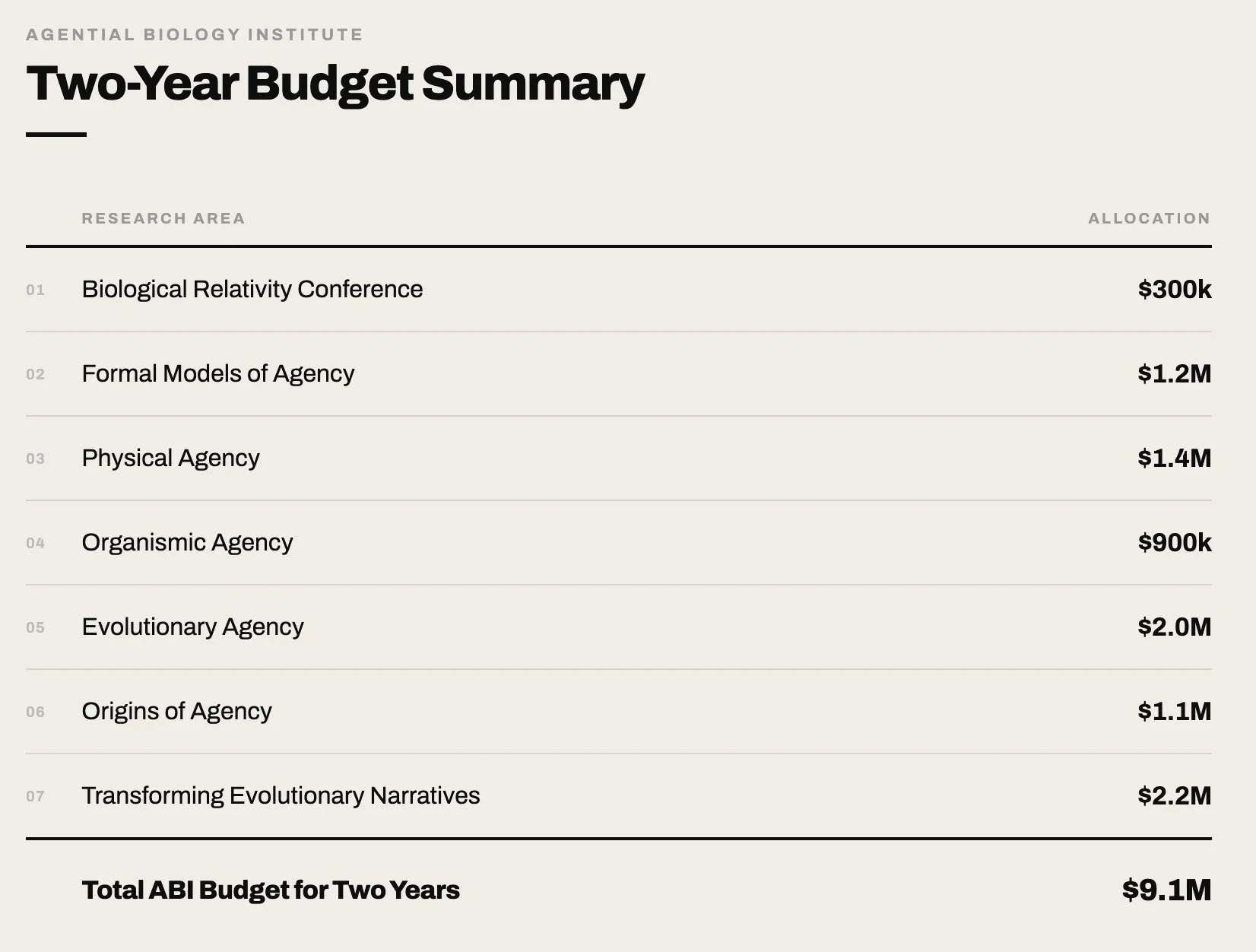
The initial work of the ABI involves both specific proposed technical projects (1-5) and also support for the broader impact of agential biology – transforming our personal and socio-cultural narratives of life (6).
The five technical projects develop specific hypotheses about the interplay of bottom-up (efficient) and top-down (formal) causes in biological systems, and the principles of biological cognition this interaction creates (memory, learning and epistemic curiosity). In particular, this builds on principles of natural induction (adaptation in biological networks, independent of natural selection) in multi-scale biological systems, but goes further to identify the mechanism responsible for embodied motivation (curiosity) characteristic of living beings.
1) Formal Models of Agency — $1.2M (2 years)
Program Fulfillment: Dr. Richard Watson, University of Southampton
This utilizes computational modelling and mathematical formalisms to develop our formal theoretical understanding of biological agency as a general inter-scale phenomenon. It extends existing dynamical systems models (learning in viscoelastic networks) to incorporate cyclic behaviours (with resonance relationships) as a formal substrate unifying cognition (memory, learning and adaptive behaviour), shape and form (development), and adaptation (including evolutionary change).
Funds would support a small theory-and-computation core to formalize biological agency and generate testable predictions for the empirical programs. The budget primarily covers 2 postdoctoral fellowships (mathematical biology/dynamical systems and computational modelling), part-time PI and scientific director effort, and research programmer support to build reusable modelling codebases, simulation pipelines, and analytic tooling (including reproducible workflows and open-source releases). Additional costs include computing (workstations, modest HPC/cloud time, data storage), software and publication expenses (preprints, open-access fees where appropriate), and cross-project integration activities (monthly theory–experiment working sessions, workshops, and travel to collaborate with partner labs). A small allocation supports graduate/undergraduate research assistants, and nonprofit operating needs tied directly to research delivery (project management, compliance, documentation, and audit-ready financial tracking for grants).
2) Physical Agency — $1.4M (2 years)
Strategic Partner: (Dr. Josh Bongard, University of Vermont)
Organisms are, in a sense, “agents all the way down”: subcellular assemblies up through ecosystems are organized such that, by developing physical agency and pursuing their own goals, they also accommodate the goals of the parts they contain and the systems of which they are a part. Inspired by this, we propose to build physical machines that embody the principle of “agents all the way down”. The approach unifies aspects of swarm robotics with active matter into what we call ‘agential matter’. Compared to existing swarm robotics, each agential ‘element’ will have only limited but essential computational and functional capabilities (analogous to an individual neuron). The focus is instead on a distributed functionality arising from the dynamic relationships between elements. Compared to existing active matter research, the collective capabilities are not just structural self-organisation or self-assembly but much more cognitive - including distributed memory, learning and adaptive behaviour. Beginning with the principles of natural induction and physical learning in viscoelastic networks, we hypothesize that this will result in interior agents that can learn to mechanically distribute surprise spreading through the agent they inhabit, to produce structural reorganisation (learning), when the latter encounters external, surprising events. This should result in the bigger agent continuing to behave as expected (finding the same goal by different means) in the face of the world’s unexpected slings and arrows. More broadly, this funding stream would help us understand the physical embodiment of agency, and demonstrate that we understand agency operationally by building it, appropriately, into machines.
This funding would support a prototyping project in a shared test facility for embodied multi-element systems and multi-timescale “agential matter” demonstrations. The budget would cover 1–2 postdoctoral fellows (robotics/distributed systems and/or active matter physics), one full-time research engineer, and technician support for fabrication, assembly, and maintenance. Significant direct costs include hardware and materials (robot swarm components, sensors, microcontrollers, actuators, rapid prototyping supplies, lab tooling), instrumentation and test infrastructure (cameras, tracking systems, benches, safety equipment), and iterative build–test cycles to validate theory through constructive demonstrations. Funds also support facility costs (bench space, utilities, insurance for equipment), collaboration travel, and documentation and dissemination (design files, open hardware repositories, demonstration videos, and public-facing materials that clarify distinctions between artificial and natural agency).
3) Organismic Agency — $900k (2 years)
Strategic Partner: Dr. Michael Levin, Tufts University
Standard accounts view the degree and type of agency exhibited by living beings as deriving, and being predictable, from the history of evolutionary selection. However, we have produced self-organizing proto-organisms (Anthrobots) made from wild-type adult human cells (no transgenes, scaffolds, or other ways to program cells). Anthrobots have unique forms, behaviors, transcriptomes, and physiology. Whence do their properties originate, given that they've not had a history of selection for properties in their new configuration and lifestyle? In our project, a combination of bench biology and computational modeling, we will: a) study novel functional, cognitive, and morphogenetic properties of Anthrobots (to establish targets that need to be explained), specifically focused on problem-solving, learning, and goal-directed activity, b) develop computational and conceptual models to facilitate prediction of these properties, and c) test those models by deriving stimuli during Anthrobots' morphogenesis. We will use tools of non-neural bioelectricity, neurotransmitter signaling, and developmental molecular physiology to learn to predict the agentic qualities of novel life forms. Our goal is to trace the origin of novel collectives' agential capacities from cells whose genetic hardware is conventionally thought to encode one outcome (the "human"), and address massive gaps in our understanding of how to predict form and function from genomic sequence and evolutionary history.
4) Evolutionary Agency — $2.0M (2 years)
Strategic Partner: Dr. Oded Rechavi, Tel Aviv University
This experimental work re-integrates biological agency with evolutionary processes to tease apart their leader-follower status in adaptive change, and the relative importance of drivers coming from selection (survival and reproduction) and agency (inductive learning). The Rechavi lab’s pioneering research demonstrated that cognition can direct inheritance (neuronal activity directs transgenerational inheritance in nematodes) not vice versa.
This budget supports the most resource-intensive experimental work: separating agency from evolutionary dynamics to disentangle agency-driven inductive adaptation from selection-driven change across multiple generations and conditions in C. elegans model organisms. The unique experimental approach is to compare: 1) adaptive phenotypic change accumulated over multiple generations whilst eliminating genotypic evolution (genetic clones and no natural selection), with the reverse, 2) genetic variation and selection whilst eliminating cumulative phenotypic change (phenotypic clones and no inheritance of acquired characters). In each case we can then release the withheld system, i.e. : 1) allow genetic evolution to respond to (canalise) the phenotypic change, 2) allow cumulative phenotypic change to respond to (accommodate) the genotypic change. Our unique experimental system thereby quantifies for the first time whether the agency of organisms drives genetic evolution more or less than genetic evolution drives organismic agency. We can also assess differences in the direction of adaptive change when led by organismic agency or selection.
Funding would cover 2 postdoctoral fellows (one experimental evolution/quantitative genetics, one systems physiology/learning dynamics), a lab manager, and two technicians to run parallel lines, maintain rigorous controls, and execute high-throughput assays. Direct costs include large-scale culturing/containment and consumables, automated manipulation (“Worm Picker” Robot), measurement and tracking, and substantial omics/phenotyping expenses (sequencing, transcriptomics or proteomics as required, plus bioinformatics support) to distinguish physiological adaptation from heritable genetic shifts. Additional funds support computational infrastructure for longitudinal analysis, replication across sites (subcontracts or partner-lab fees), and robust governance (data audits, preregistration, independent advisory input, and dissemination). This category also carries a proportionate share of nonprofit compliance and operations needed for multi-site research management and grant stewardship.
5) Minimal Chemistry of Learning — $1.1M (2 years)
Primary Investigator: Dr. Joana C. Xavier
Strategic Partner: Dr. Eloi Camprubi, Univ. Of Texas Rio Grande Valley
This program tests whether natural induction can arise in pre-genetic chemistry when fast reaction dynamics are embedded in slow, plastically reconfigurable materials. Rather than treating reaction networks in isolation, we will study chemically active material systems—chemical gardens—which are porous precipitate natural reactors with compartmentalized mineral–fluid interfaces that naturally introduce slow material degrees of freedom (e.g., surface conditioning and ageing, pore formation and topology, compartment permeability) capable of being modified by repeated chemical flux. Using controlled flow cycling of families of related chemical inputs, we will condition these structures and then test whether their subsequent chemical responses to novel—but chemically related—inputs are measurably biased in a history-dependent way, as evidenced by altered spatiotemporal reaction localization, pathway canalization, or stability of reaction zones relative to fresh structures. To start, we will test linear reaction pathways (e.g., CO2 reduction into simple organics) to establish a baseline for understanding the reactivity landscape of our naturally precipitated chemical garden. We will follow by introducing known autocatalytic reaction sets (e.g., formose reaction) in order to assess whether natural induction promotes higher-order adaptation on self-amplifying chemical networks compared to linear pathways. Demonstrating this selective, correlation-dependent reconfiguration of material constraints—distinct from trivial yield increases or monotonic accumulation—would provide the first empirical evidence that natural induction operates in natural chemistry prior to genetic encoding, grounding the emergence of adaptive constraint bias in geological materials and positioning universal metabolic, genetic and cellular autocatalysis as a downstream consequence of inductive geochemical organization.
Funds will support one postdoctoral fellow (geochemistry/analytical chemistry), one part-time research technician, and part-time PI and co-PI effort. Direct costs include custom flow reactor fabrication capable of maintaining out-of-equilibrium conditions across porous mineral matrixes, mineral and compartmentalization substrates, consumables, and analytical instrumentation access and maintenance (chromatography, mass spectrometry, nuclear magnetic resonance, bulk mineral and surface characterization). Additional support covers quantitative analysis of dynamical responses, integration with theoretical predictions from the formal agency program, and dissemination via open data, publications, conference travel, and cross-project workshops. The project is deliberately scoped to deliver a decisive test of pre-genetic natural induction within two years.
6) Transforming Evolutionary Narratives — $2.2M (2 years)
Primary Investigator: Charlie Munford
Program Fulfillment: ABI Officers and Staff
This set (1-5) of innovative technical projects (and the future technical work they will open-up) are only part of broader ambition for the ABI – biological agency is not just a matter of updating scientific knowledge. At both a personal and global socio-cultural level, our narratives about the science of biological agency deeply affect our understanding of what life is and our part in it: Are we ‘lumbering robots’ serving the survival and reproductive imperatives of our genes, or are we creative agents in the living universe? The ABI will support public content and inter-disciplinary dialogues that seek to expand and deepen our interpretation of life, its purpose and meaning, and its importance for human values.
This budget supports two areas:
1) Pump-priming research. A small portion of this amount (approximately $250k over two years) will be used for public-facing experimental demonstrations meant for online engagement, critical proof-of-concept computational modeling that orients other research activities, and low-cost empirical tests not otherwise accounted for in the main research program. This will be administered by Charlie Munford in a role as the primary investigator in these activities. One area of focus will be a full computational model of a Popperian resonant system.
2) Public outreach. ABI’s broader-impact work is translating technical advances into durable interdisciplinary dialogue and high-quality public scholarship on what biological agency implies for human meaning and values. Funding would cover a program director (full-time), science communications/editorial staff, operations staff, and fellows-in-residence or visiting scholars (short-term stipends for philosophers, historians of science, cognitive scientists, artists, and educators), paired with a media-forward program that translates ABI’s technical results into compelling public narratives. Direct costs include production of a flagship video series and podcast (researcher interviews, explainers, and documentary-style field pieces), professional editing and post-production, studio time, transcription, accessibility services (captions, translations where appropriate), and distribution/marketing to reach both scientific and general audiences. The budget also supports two annual interdisciplinary symposia designed as “content-generating convenings,” with travel support for invited participants, high-quality recording of lectures and panels, and downstream conversion into open educational materials (curricula modules, essays, case studies, and short explainer media) aligned with ABI’s research outputs. A portion supports impact evaluation (surveys, qualitative interviews, analytics, outcomes tracking), partnership subgrants with universities, museums, and media outlets to amplify reach, and the nonprofit infrastructure required for responsible public scholarship—contracts and releases, accessibility, legal review, archiving, and donor/grant compliance—ensuring the narrative work remains anchored to, and iteratively informed by, the technical program.
Outcomes and Evaluation
The ABI commits to test underexplored hypotheses with mainstream-level rigor: preregistration where appropriate, open datasets/tooling, and publishing regardless of direction. These specific projects have been selected, where appropriate, as critical tests of two plausible hypotheses. We strive to design experiments for their ability to deliver actionable insight regardless of the outcome of the trial.
1) Formal Models of Agency
ABI will deliver formal definitions and computational models that generate falsifiable predictions about how efficient and formal causes interact to produce learning, memory, development, and adaptation across scales. Outputs include open modelling code, prediction sets, and at least one major theory manuscript. Success will be evaluated by the number of effective empirical tests derived from the models and evidence of predictive fit in at least one experimental platform.
2) Physical Agency
ABI will build and validate physical demonstrations of multi-scale agency (e.g., a multi-element robotic system and an active-matter analogue) that instantiate learning-like, history-dependent adaptation under perturbation. Outputs include benchmarked performance metrics, open hardware/design documentation, and publishable demonstrations. Success will be evaluated by repeatability, alignment with Project 1 predictions, and external reuse through collaborations, publications, or adoption by partner groups.
3) Organismic Agency
ABI will produce standardized biological models that quantify organismic problem-solving and learning while controlling for genetic evolution, alongside preregistered protocols and curated datasets. Outputs include validated measurement pipelines and at least one publication-quality dataset linking behaviour/physiology to the agency framework. Success will be evaluated by assay reliability, replication/transfer to partner labs, and clear constraints the results place on the formal models.
4) Evolutionary Agency
ABI will generate multi-generation experimental datasets that disentangle agency-driven inductive adaptation from selection-driven genetic change, supported by preregistration and omics-enabled attribution. Outputs include robust protocols, longitudinal datasets, and at least one major manuscript. Success will be evaluated by interpretability (clean separation of drivers), replication across lines/sites, and follow-on traction such as new grants or independent uptake.
5) Origins of Agency
ABI will establish a reproducible chemical/minimal-system platform that tests whether history-dependent, learning-like dynamics can emerge under controlled cycling and multi-timescale organization. Outputs include a validated experimental system, quantitative signatures of adaptive dynamics, and a theory–experiment integration note or manuscript. Success will be evaluated by reproducibility, mechanistic clarity, and how directly results confirm or refine the core models.
6) Transforming Evolutionary Narratives
ABI will produce a sustained public-facing program—podcast/video series, recorded symposia, and open educational materials—translating technical results into credible narratives about biological agency and its implications. Outputs include regular releases, fellows/visiting-scholar contributions, and partnership distribution through universities, museums, or media outlets. Success will be evaluated by reach and engagement, quality signals (expert participation and editorial rigor), and measurable program value to the science (recruitment, collaborations, and fundraising that strengthen Projects 1–5).

Managing Officers
Agential Biology Institute is managed primarily by Richard Watson and Charlie Munford, with help from a lean but well-qualified senior team.
Charlie Munford, President
Richard Watson, Chief Scientific Officer
Joana Xavier, Consulting Bioengineer
Joshua Wolk, Operations
Dina Rudick, Communications
Lizzie Devane, Fundraising
Richard A. Watson (Chief Scientific Officer) is a computational evolutionary biologist and senior professor in the Department of Computer Science (Agents, Interaction and Complexity group) at the University of Southampton, UK. His work bridges evolutionary dynamics, learning theory, and collective intelligence. He is best known for showing how standard evolutionary processes can implement forms of learning, memory, and inference normally associated with neural networks—most prominently in his theory of natural induction, which proposes that evolution can accumulate structured biases (inductive priors) that guide future variation and adaptation.
Charlie Munford (President) is an entrepreneur-scholar whose career bridges forest science, theoretical biology, and early-stage venture building; he holds an MFS from Yale, has published in the peer-reviewed AGI 2021 proceedings and Communicative and Integrative Biology, and has founded or worked as first FTE in multiple successful early-stage ventures, including Flying M Farm, Two Run Farm, VotingWorks and Banjo Tree Service. His central theoretical contribution, epistolution, proposes a unifying mechanism of knowledge creation in living systems. Munford also hosts the Agential Topics meetings on YouTube, a seminar-style series that convenes leading thinkers in systems biology, cognitive science, and theoretical neuroscience to discuss agency, causation, inference, basal cognition, and the search for general principles linking biological organization and intelligence.
Joana Xavier (Consulting Bioengineer) is a bioengineer and computational biologist based in London whose research focuses on minimal and chassis cells, the origins of cells and early evolution, especially how the first cells could have emerged from prebiotic geochemistry through primitive metabolism, autocatalytic networks, and “minimal life” constraints. Her work often uses systems and network biology—linking metabolic network structure to deep evolutionary questions such as the nature of early cellular organization and reconstructions related to the Last Universal Common Ancestor (LUCA)—and she has published widely across origin-of-life, metabolism, and computational biology. She is also active in community-building for the field, including co-founding the Origins of Life Early Career Network (OoLEN) and contributing to broader, integrative perspectives on how to synthesize evidence across competing origin-of-life frameworks. Joana is also a referee for the Evo 2.0 $10M prize on the origins of coding, judged by Denis Noble and George Church. Joana also has been a founder and CEO for a tech startup and advised multiple startups and VCs.
Joshua Wolk (Operations) comes from a legal and academic background. He provides rigorous legal reasoning, structural clarity, and strategic judgment with strong analytical, organizational, and advocacy skills, all of which support the Agential Biology Institute’s governance, partnerships, and long-term institutional development.
Dina Rudick (Communications) is an award-winning photojournalist, documentary filmmaker, and visual strategist whose work distills scientific, environmental, and human-systems stories into compelling visual narratives that elevate public understanding of complex ideas.
Lizzie Devane (Fundraising Consultant) is a seasoned project manager and operations lead with deep experience coordinating research, media, and creative teams, providing the logistical, organizational, and strategic infrastructure required for a growing scientific institute.

Strategic Partners
Dr. Michael Levin is the Vannevar Bush Distinguished Professor of Biology at Tufts University (also a professor of Biomedical Engineering) and a leading figure in regenerative and developmental biology, best known for pioneering work on developmental bioelectricity—how networks of cells use electrical signaling to coordinate pattern formation, morphogenesis, and regeneration. He directs Tufts’ Center for Regenerative and Developmental Biology and is also the director of the Allen Discovery Center at Tufts, where his lab blends experimental embryology with computational modeling to study and control the “collective intelligence” of cells as they make decisions about growth and form. Levin is also widely recognized for co-leading the work that introduced Xenobots—computer-designed, living machines built from frog cells, and Anthrobots - self-organizing healing biobots made from adult human cells —highlighting new ways to probe and harness biological organization for applications spanning regenerative medicine and bioengineering.
Dr. Josh Bongard is a Professor of Computer Science at the University of Vermont, where he leads the Morphology, Evolution & Cognition Laboratory, and is co-director with Michael Levin of the Institute for Computationally Designed Organisms. He researches evolutionary robotics, evolutionary computation, and physical simulation—especially how body design (morphology) and evolutionary processes shape adaptive behavior and cognition in machines. He is widely known for work on self-modeling and automated robot design, and he co-led research that introduced “Xenobots,” a new class of living, programmable biological machines. His contributions have been recognized with major early-career honors including a Microsoft Research New Faculty Fellowship, MIT Technology Review’s “TR35,” and the U.S. Presidential Early Career Award for Scientists and Engineers (PECASE).
Dr. Oded Rechavi is a professor at Tel Aviv University in the School of Biochemistry, Neurobiology and Biophysics, where he leads the Rechavi Lab, a research group known for testing—and often challenging—core assumptions about heredity and biological information flow. His work uses tractable genetic model organisms (especially C. elegans) to study how experiences can produce heritable molecular signals, with a particular emphasis on small-RNA–mediated transgenerational inheritance and “molecular memory”—mechanisms by which environmental challenges can shape gene regulation and phenotypes across multiple generations without changes to DNA sequence. In particular, they’ve shown that small RNA production in the brain and brain activity direct the inheritance of small RNAs across generations.
Marco Cavaglià is a senior researcher and bioengineer in the Department of Mechanical and Aerospace Engineering at Politecnico di Torino, where his multidisciplinary work bridges neuroscience, bioengineering, and fundamental information theory applied to brain function; he holds an M.D. and a Ph.D. and has published extensively on neural mechanisms, neuroprotection, and information encoding in biological systems, including research on cardiac–brain interactions and medical device innovation such as non-invasive respiratory support developed during the COVID-19 pandemic. At Politecnico, his Energy-Mass-Information (EMI) group investigates how physical substrates such as lipid membranes and electromagnetic fields contribute to neural information processing and coherence, seeking to unify concepts from physics and biology to explain cognition and memory. He is also a leading proponent of a holographic brain theory—exemplified in his jointly authored Frontiers in Neuroscience paper—that proposes the brain may use coherent dipole oscillations and resulting electromagnetic interference patterns to encode and retrieve information in a distributed, hologram-like manner, integrating insights from physics, neural dynamics, and information theory into a novel paradigm of cognitive processing.
Dr. Eloi Camprubi is an assistant professor in the School of Integrative Biological and Chemical Sciences at The University of Texas Rio Grande Valley. He specializes in prebiotic chemistry and planetary sciences, with expertise in connecting biology, chemistry, and geology to address the origins and distribution of life. His research laboratory (https://eloicamprubi.com/) is funded by 2 NASA, 1 USDA, 1 NSF, and 1 UT System grants. His team is currently composed of 2 postdoctoral researchers, 1 laboratory technician, and 2 PhD, 4 MS, and 3 undergraduate students. He has been awarded fellowships from the Human Frontier Science Program, the Dutch Origins Center, UCL Impact Awards, and ‘la Caixa’ Foundation. He is also a member of the Board of Directors of the NASA Texas Space Grant Consortium and the Professional Outreach Lead of the South Texas Space Science Institute.
Summary
All donations to scientific or medical research hope to spur progress, but some opportunities for lasting impact are truly unique. Your investment in the Agential Biology Institute would not simply fund scientific business as usual; it would help establish a visible and credible anchor for a new way of looking at the entire living world. This would offer a gateway to a deep and lasting medical, social, and scientific vision across all sectors. If the cognition-first paradigm succeeds, it will come to dominate the discourse in all the life sciences and technological fields for many decades to come, unlocking transformative potential that is hard to overestimate. The work is already underway, the team is in place, and the path is clear.
I would be honored to partner with you in making this vision concrete.
Thank you for your consideration.
Sincerely,
Charlie Munford
President, Agential Biology Institute
email : charlie.munford@gmail.com cell: 504-717-0884
Scientific Board of Advisors
Agential Biology Institute is advised on scientific and organizational strategy by a senior team of world-class researchers.
Scientific Advisory Board
Denis Noble
Michael Levin
Stuart Kauffman
Kate P. Kauffman
Perry Marshall
Steven Lehar
Denis Noble — Denis Noble is a Fellow of the Royal Society and an Oxford physiologist and pioneer of computational physiology—credited with early mathematical models of cardiac cells—and a leading advocate of “biological relativity,” arguing there is no privileged level of causation in biology.
Michael Levin — Michael Levin is a Distinguished Professor of Biology at Tufts University (Vannevar Bush Chair) and director of the Tufts Center for Regenerative and Developmental Biology, known for pioneering work on bioelectric signaling in morphogenesis, regeneration, and collective cellular decision-making.
Stuart Kauffman — Stuart Kauffman is a theoretical biologist and physician best known for foundational work on self-organization in biology, including NK fitness landscapes and autocatalytic-set theories for the origin of life and evolution.
Katherine P. Kauffman — Katherine Peil Kauffman is a scholar and founder/director of EFS International whose work emphasizes emotion as a self-regulatory sense and its implications for human cognition, meaning, and culture.
Perry Marshall — Perry Marshall is an author and entrepreneur best known for Evolution 2.0 and for founding the Evolution 2.0 Prize, bringing an engineering and information-theory lens to debates on evolution and the origin of biological information.
Steven Lehar — Steven Lehar is an independent vision researcher and theorist best known for developing harmonic resonance theory, an alternative neurocomputation framework that argues perceptual organization and Gestalt “wholeness” can be understood in terms of spatiotemporal standing-wave (resonant) dynamics in neural tissue rather than purely neuron-to-neuron symbolic signaling.
Letters of Support from Scientific Advisory Board
Dr. Michael Levin
1/4/26
Distinguished Professor Michael Levin
Allen Discovery Center
Tufts University
200 Boston Ave., room 4604
Medford, MA 02155-4243
Tel. (617) 627-6161
email: michael.levin@tufts.edu
To Whom It May Concern,
I am very pleased to offer my strongest support for the formation of the Agential Biology Institute, a new nonprofit founded by my colleague and co-author Richard Watson (University of Southampton) together with Charlie Munford (Agential Topics). Dr. Watson is an exceptionally rigorous, unique, and original thinker whose scholarship bridges evolutionary theory, computation, and the dynamics of adaptation in ways that open genuinely new research directions; he combines strong technical depth with a rare ability to frame testable questions that connect across disciplines. Mr. Munford brings entrepreneurial drive, intellectual seriousness, and practical convening capacity, with a demonstrated record of building communities that translate big ideas into productive working conversations and actionable research agendas. The Institute’s focus on the evolutionary and physiological mechanisms of embodied cognition is both timely and important: biology increasingly demands frameworks that treat living systems as agents—competent, goal-directed, and historically shaped—rather than as passive machines. Creating a durable home for conferences, working meetings, and collaborative research in this area will strengthen the field by accelerating synthesis across developmental biology, physiology, evolution, and cognitive science, and I believe Agential Biology Institute is well-positioned to make meaningful contributions.
Sincerely,
Michael Levin
Vannevar Bush Chair
Tufts University, and
Wyss Institute, Harvard
Dr. Denis Noble, CBE FRS
Denis Noble CBE FRS
Department of Physiology, Anatomy & Genetics, and Balliol College
Oxford University
OX1 3BJ, UK
denis.noble@balliol.ox.ac.uk
denis.noble@dpag.ox.ac.uk
February 9, 2026
To whom it may concern,
I am pleased to offer my strong support for the establishment of the nonprofit Agential Biology Institute (ABI). ABI’s mission is complementary to the aims of the Third Way of Biology community and to the broader orientation sometimes described as biological relativism: the recognition that causation in living systems is distributed across multiple levels of organization, with no single privileged “master level.”
ABI is being founded at an opportune moment. Biology increasingly confronts phenomena—robust physiological regulation, developmental plasticity, regeneration, adaptive behavior, and multi-scale coordination—that cannot be adequately understood through one-way, gene-centric narratives or by treating organisms as passive readouts of molecular instructions. ABI’s emphasis on biological agency and multi-level, relational explanation is therefore a necessary corrective, closely aligned with the Third Way’s insistence on taking organismal and physiological processes seriously.
I am particularly encouraged by the calibre and complementarity of the organizing team. I have come to know Charlie Munford through his energetic organization of the Agential Topics Group and through his participation in my NOBLE group of younger researchers; he brings unusual intellectual range and a rare ability to convene sustained cross-disciplinary work. Richard Watson (University of Southampton), known to me through his work on natural induction, brings the kind of rigorous theory-building needed to formalize agency and multi-scale organization without lapsing into metaphor. Joana Xavier, known to me through her origins-of-life research, her role as a judge for the Evolution 2.0 Prize with which I have been involved, and her leadership in founding the OOLEN group of young origins researchers, adds foundational expertise and demonstrated capacity to build serious research networks. Together, they combine community-building, formal machinery, and origins-level grounding in a way the field rarely achieves.
ABI’s focus is not merely philosophical; it has direct consequences for medicine, public health, and technology. When we misconstrue causation in living systems—reducing adaptive physiology to a single level—we risk interventions that are brittle, overly narrow, and poorly personalized. A mature, multi-level science of agency and causation can help move from generic appeals to “complexity” toward operational conceptual, mathematical, and experimental frameworks that clarify which levels matter, how they interact, and how regulation and context shape outcomes.
For these reasons, I strongly endorse ABI’s formation and encourage funders, collaborators, and academic partners to support it as a timely and serious institutional vehicle for advancing scientifically adequate and socially meaningful biology.
Sincerely,
Denis Noble, CBE, FRS
Emeritus Professor of Cardiovascular Physiology
University of Oxford
Co-founder, Third Way of Evolution
Dr. Stuart Kauffman & Katherine Kauffman
January 8, 2026
To Whom It May Concern,
We are pleased to offer our strong support for the Agential Biology Institute (ABI), a new nonprofit founded by Charlie Munford and his colleague Richard Watson of the University of Southampton. Charlie is host of the Agential Topics, a working group frequented by cutting edge scientists, philosophers, and intellectual leaders engaged as both members and guest speakers. Dr. Watson is a rigorous and imaginative scholar whose work in evolutionary theory and complex adaptive systems brings unusual conceptual clarity and technical depth to questions about how novelty, learning, and agency arise in living systems. As members, we find the synergy ignited within this group to be compatible with the very best from both established and theoretical biology (my domain) and biophysical emotion theory (the domain of my wife). Mr. Munford combines intellectual rigor with the practical capacity to convene and sustain high quality interdisciplinary collaboration; through Agential Topics he has demonstrated a rare talent for turning wide-ranging inquiry into disciplined, productive dialogue and durable research momentum. Establishing the ABI seems the next logical step for broader collaborative inquiry and deeper impact. ABI’s mission—advancing conferences, working meetings, and research on the evolutionary and physiological mechanics of embodied cognition—addresses a foundational gap in contemporary biology: the need for integrative frameworks that treat organisms as agents embedded in and cocreating their environments, rather than as passive products of linear causation. We believe ABI’s approach is both scientifically valid and strategically important, and that Munford and Watson have the capability, judgment, persistence and charisma required to build an institution that catalyzes meaningful progress in this emerging field. Our endorsement is actively instantiated by our commitment to serve as board members.
Sincerely,
Stuart A. Kauffman
Emeritus Professor of Biochemistry, University of Pennsylvania
Institute for Systems Biology
Marshall Scholar
MacArthur Fellow
Katherine Peil Kauffman, Director, EFS International
Affiliate: Harvard Divinity School
Northeastern University.
Perry Marshall
Perry Marshall
Evolution 2.0
805 Lake Street #295
Oak Park IL 60301 USA
To Whom It May Concern,
I write in enthusiastic support of the Agential Biology Institute, founded by Charles Munford and Dr. Richard Watson. As an entrepreneur bridging business strategy and cancer research, and as a board member invested in this initiative, I've experienced the potential of their work.
The prevailing reductionist paradigm in biology has extracted an enormous cost. Not merely in delayed scientific progress, but in human suffering. I've worked for six years with oncologists and researchers who battle a disease that consistently outmaneuvers our models. Cancer cells demonstrate agency, adaptability, and memory that cannot be explained by restricting biology to mere chemistry and physics.
When frameworks treat living systems as passive machines, we blind ourselves to the very mechanisms we most need to understand.
The vocabulary of mainstream biology reveals this failure: “Junk DNA," "frozen accidents," "evolutionary leftovers," "degenerate code." This is the language of a profession that has systematically denigrated the sophistication of the very things it purports to study. These terms aren't just imprecise. They betray a fundamental misapprehension of how life works.
Agential Biology Institute brings a necessary correction. By treating organisms as agents, competent, goal-directed, historically shaped, embedded in environments they actively co-create… ABI opens research pathways that reductionism has closed off.
Charlie Munford has built something special in Agential Topics, an online community where rigorous experimentation meets intellectual courage. Dr. Watson brings the technical depth and conceptual clarity essential for translating bold ideas into testable hypotheses. They've created a space where scientists, philosophers, and practitioners can pursue questions about agency, memory, cognition, and adaptation, without apology. Without the artificial constraints of outdated frameworks.
The implications extend far beyond academic biology. Agency alters the way we practice immunology, drug development, environmental science, even economics. When we acknowledge that living systems possess their own goals, learning capabilities and adaptive strategies, we gain access to interventions that reductionism cannot see.
The Agential Biology Institute is sharpening our senses, bringing the full majesty of life back into the life sciences. Not by surrendering rigor, but by expanding it to match the real world complexity and agency we observe in every living system. "The world is full of magic things, patiently waiting for our senses to grow sharper."
This project is both scientifically necessary and hopeful for humanity. I am honored to serve on the board and offer my strongest support for this venture.
Sincerely,
Perry Marshall
Board Member, Agential Biology Institute
Co-Founder, AACR Cancer & Evolution Working Group
Author, Evolution 2.0